MVP stands for Minimum Viable Product. It is the smallest version of your app that solves a real problem for real users and can be launched on the market. Not a prototype, not a demo, but a working product with a small yet complete scope. The goal is a single one: to learn from the market as early as possible, before you have spent the budget on the full vision.
Why an MVP, not the full product right away
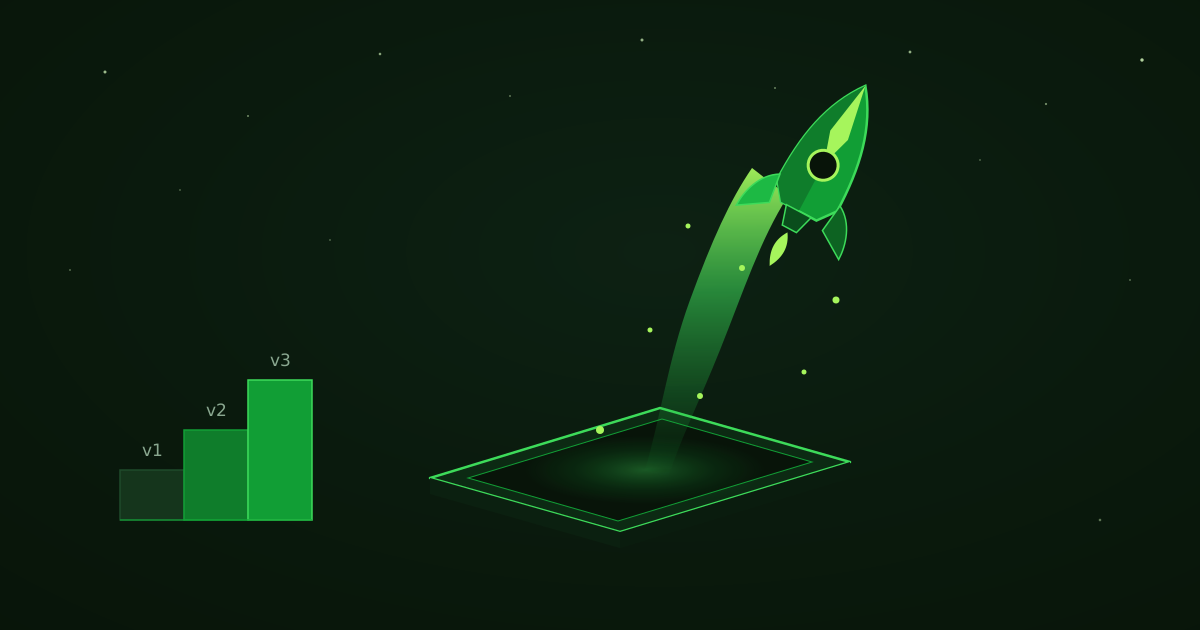
Because at the start of every product there are hypotheses, not facts. You think users want something, but you do not know. Every month of development before the first real user is a month in which you pile up risk: the market moves, the budget melts and there is no feedback. The MVP flips the equation: you launch the core in months, gather real behaviour and build on from data rather than from assumptions.
How to cut scope without cutting value
This is where the whole exercise is lost or won. The rule is simple: you cut breadth, you keep depth.
Find the core action
Every successful app has one action the user opens it for: I order food, I book an appointment, I track a workout. Define it in a single sentence. Everything in the MVP serves that action.
Apply the “will the scenario break” test
For every feature on the wish list, ask: if it were missing, would the user still be able to perform the core action? Profile photos, dark mode, a second language, achievements and badges: almost always the answer is “they would”. In that case the feature goes on the list for version 2, not in the bin.
Use ready-made building blocks where you can
Login through Google and Apple instead of your own system with confirmations, ready-made services for payments and notifications, an admin panel on a ready-made foundation. Cross-platform development with Flutter or React Native, so you cover iOS and Android with one codebase.
The typical mistakes we see
- Perfectionism. “Let us just polish this one more screen and then we launch.” Six months later the screen is perfect and there are no users. Version 1 has to be good, not flawless.
- Too many features. The fear that “without this nobody will use it” stuffs the first version with everything. The result is a later launch, a higher budget and a blurrier product.
- An MVP without quality. The opposite extreme: a buggy version shipped in a hurry. The user does not know this is an MVP. They see a broken app, leave one star and do not come back.
- Launching without measuring. An MVP without analytics is like an experiment without recording the results. The whole point is the learning.
The MVP approach versus “everything at once”
| Criterion | MVP approach | Everything at once |
|---|---|---|
| Time to market | Usually 2 to 4 months | Often a year or more |
| Initial budget | A small part of the full vision | The whole budget before the first user |
| Risk | Low: mistakes are found cheaply and early | High: a wrong hypothesis is discovered only at the finish |
| Feedback | From real users after months | Only internal opinions right up to the end |
| Growth | Version 2 is built on real data | Reworks after launch are expensive and painful |
How to measure the success of an MVP
Not by the number of downloads. Downloads are vanity if people do not come back. Watch the metrics that answer the question “are we solving a real problem”:
- Activation: what share of those who installed reach the core action at least once.
- Retention: how many of them come back after a week and after a month. This is the most honest metric.
- Frequency: how often active users perform the core action.
- Qualitative feedback: what the first users say in conversations and reviews. At this stage ten deep conversations are worth as much as a thousand surveys.
What comes after the MVP
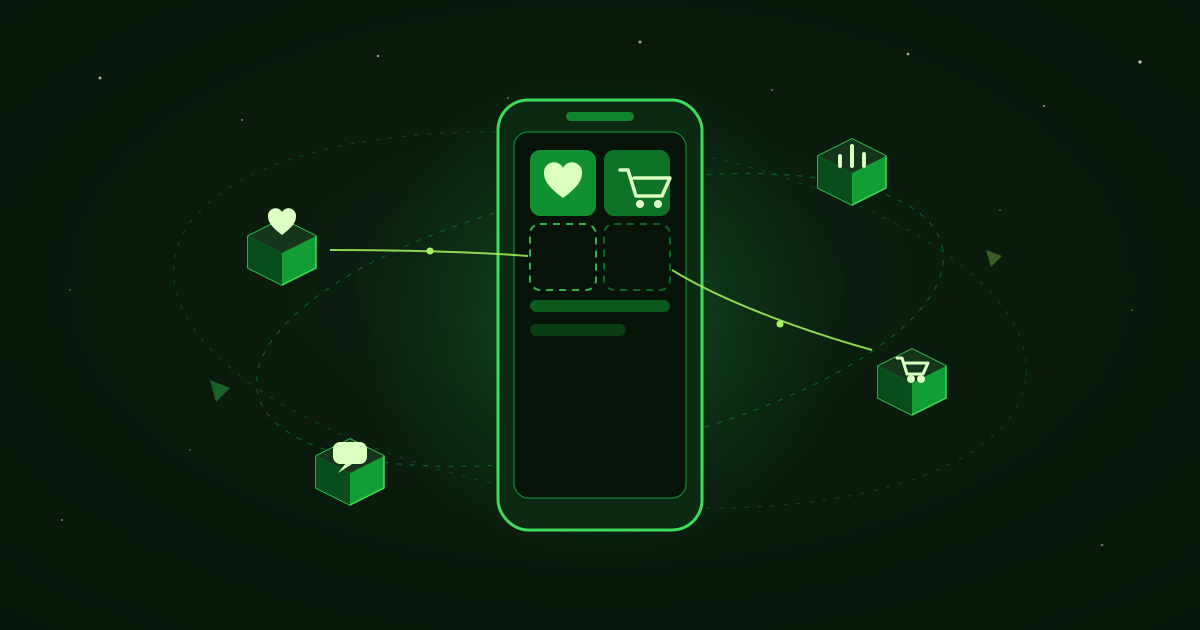
If the metrics are good, the path is clear: you prioritise the next features by what active users want and you build version 2, 3 and onward on the same foundation. If the metrics are weak, the MVP has saved you the most expensive mistake: a full product that nobody wants. You correct the hypothesis, the scope or the audience and try again with a small investment.
If you have an idea and want to launch it on the market in months, see how we approach it on the page for mobile app development. We also help with the hardest part: deciding what should NOT go into the first version.
Frequently asked questions
Does MVP mean an unfinished or low-quality product?
No. An MVP is small in scope but complete in quality. The few features it includes must work flawlessly and look good. You cut the number of features, not the quality of how they are built.
How long does it take to build an MVP app?
With a disciplined scope the typical timeline is two to four months from start to publishing in the stores. If the plan goes beyond that, the scope is usually too large for a first version and another round of cutting is worth it.
How do I decide which features go into the MVP?
Define the core action the user opens the app for, and include only the features on the path to it. A useful test for each feature: if it were missing, would the core scenario fail? If the answer is no, it stays out of the first version.
What happens if the MVP version does not take off?
That is exactly why the MVP approach exists: you find out cheaply and early. The data from real users shows whether the problem is in the product, in the audience or in the idea itself, and you can correct course before you have invested the budget for the full product.
Is the MVP code thrown away afterwards?
With a well-built MVP, no. When the first version is written cleanly and on top of modern technology like React Native or Flutter, the next versions are built on it. A rewrite is mostly needed when the MVP was put together carelessly with no thought for what comes next.
Related reading
Your idea deserves real users, not waiting.
Tell us what you are building and we will propose an MVP scope with a timeline and a price. We reply within 24 hours.